The clinical record
Thymosin alpha-1: cell counts and survival
The immune-cell results are intriguing. The survival results demand a separate reckoning.
From calf thymus to thymalfasin
The starting material was calf thymus. In the 1977 isolation paper, Goldstein and colleagues purified and sequenced a 28-amino-acid peptide from thymosin fraction 5. Thymalfasin is its sequence-identical synthetic version; the 2020 literature review describes drug approval in more than 35 countries, with chronic viral hepatitis central to its clinical history.
That history earns thymosin alpha-1 a serious hearing, in my estimation. It also creates a temptation to let longevity stand in for a convincing result in every new illness. Each clinical setting has its own record. US marketing approval remains absent; access to compounded thymosin alpha-1 requires an individual prescription decision, and that medicine has no FDA approval. International approvals apply to specific regulated formulations.
Counting immune cells
In the retrospective cohort of 76 patients with severe COVID-19, treatment was associated with higher blood T-cell numbers in patients with severe lymphocytopenia, meaning depleted lymphocyte counts. The investigators also reported reduced PD-1 and Tim-3 expression on CD8+ T cells, markers used to examine T-cell exhaustion. Mortality was 11.1% in the treated group and 30.0% in the comparison group, P=0.044. This was a single-institution retrospective study, with the limits on causal inference that design brings.
The cell measurements justify further investigation; assigning the survival difference to thymosin alpha-1 alone asks more of that design than it can deliver. The larger COVID-19 literature has been inconsistent.
The dendritic-cell experiments in mice and human cells offer another complication. Alongside T-helper-1 priming, thymosin alpha-1 activated IDO, an enzyme involved in breaking down tryptophan, and supported a regulatory environment involving interleukin-10 and regulatory T cells. ‘Immune booster’ leaves much of that biology out.
Sepsis mortality: ETASS, TESTS
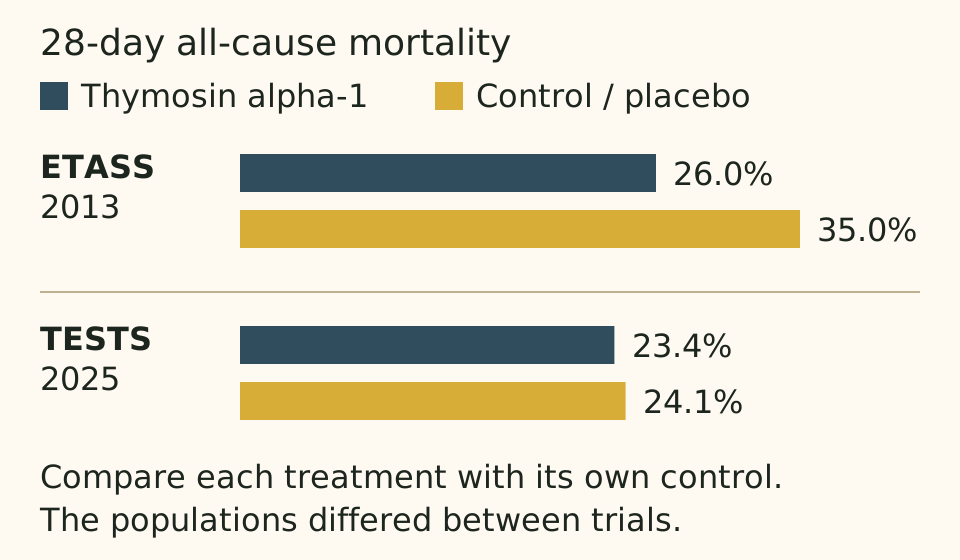
The 2013 ETASS trial enrolled 361 patients with severe sepsis. Its 28-day mortality figures were 26.0% with thymosin alpha-1 and 35.0% in controls; the primary analysis did not reach conventional statistical significance. The 2025 TESTS trial was double-blind, placebo-controlled and much larger: 1,106 adults across 22 centres. Mortality was 23.4% versus 24.1%, hazard ratio 0.99, 95% CI 0.77–1.27, P=0.93.
Those later numbers have substantially cooled my optimism about sepsis. For sepsis survival, TESTS deserves priority. The bars below compare treatment and control within each trial; the trials enrolled different populations, so comparing one trial's mortality directly with the other's would be misleading.
What the research shows
Biochemical foundation. The foundational work by Goldstein and colleagues in 1977 isolated Thymosin Alpha-1 from calf thymus (thymosin fraction 5) and determined its complete 28-residue, acetylated sequence — establishing the structural basis for all subsequent pharmacology [7].
Mechanistic definition. A pivotal 2006 study in mouse and human dendritic cells mapped the dual immunomodulatory signature: Thymosin Alpha-1 activates IDO tryptophan catabolism via TLR9 and type I interferon receptor signaling, generating a tolerogenic regulatory-T-cell environment even as it drives Th1 priming [6]. That paper established the molecular basis for the peptide's context-dependent behavior.
Sepsis — two trials, diverging results. The earlier ETASS trial (2013, 361 patients with severe sepsis) reported lower 28-day mortality with Thymosin Alpha-1 versus controls — 26.0% versus 35.0% — accompanied by improved HLA-DR expression on monocytes, though the absolute difference did not reach conventional statistical significance with its primary analysis [5]. The definitive response was the 2025 TESTS trial (1,106 adults, 22 centres, double-blind, placebo-controlled, phase 3): 28-day all-cause mortality was 23.4% in the thymalfasin group versus 24.1% for placebo, hazard ratio 0.99 (95% CI 0.77–1.27), P=0.93 — a null result [1]. Taken together, the sepsis story is one of a hopeful earlier signal that did not replicate at scale.
Access is a separate question. In the prescription-only setting, Promise Peptides (mypromise.com) now prescribes thymosin alpha-1; its licensed U.S. clinicians examine each request and may decline it. Its care excludes patients outside the U.S.; even within the country, the state and the proposed treatment restrict what it offers. Its compounded thymosin alpha-1 has no FDA approval; prescribing does not add weight to the studies summarized here.
COVID-19. A retrospective cohort study of 76 patients with severe COVID-19 reported significantly lower mortality in the Thymosin Alpha-1 group (11.1% versus 30.0%, P=0.044), alongside restoration of blood T-cell numbers in patients with severe lymphocytopenia and reversal of T-cell exhaustion markers (reduced PD-1 and Tim-3 expression on CD8+ T cells) [3]. The retrospective, single-institution design limits causal inference, and later systematic reviews of the broader COVID-19 literature found inconsistent effects.
Oncology. A 2019 reappraisal positioned Thymosin Alpha-1 as an immunostimulatory adjuvant in oncology — studied in combination with chemotherapy and checkpoint inhibitors for melanoma, hepatocellular carcinoma, and lung cancer. The proposed mechanisms include helping dendritic cells convert a "cold" (immunologically excluded) tumor microenvironment toward one more accessible to immune attack, and potentially mitigating checkpoint-inhibitor toxicity by engaging the IDO-regulatory arm [4].
Safety and tolerability. A comprehensive review of four decades of clinical literature characterizes thymalfasin as generally well tolerated, with the dominant adverse effects being mild local reactions at the injection site — redness, itching, or brief stinging — across hundreds of thousands of treated patients, with no documented organ toxicity at studied doses [2].
Tolerability and special populations
The clinical review describes generally good tolerability, with local injection-site irritation, redness and discomfort the most common adverse effects. Dedicated pregnancy and lactation safety studies are absent. Research-grade material adds uncertainty about identity, purity, actual content and sterility. Those are material-quality risks as well as questions about the peptide itself.
Autoimmune disease and solid-organ transplantation raise theoretical concerns because immune stimulation may work against the needs of those conditions. The regulatory immune mechanisms make the biology more complex, without settling safety for those populations.
Community accounts describe fewer respiratory illnesses, steadier energy, local reactions, occasional flu-like feelings and sometimes no perceived change. These are anecdotal reports, not clinical evidence. I regard the reports as questions awaiting proper measurement; they cannot establish prevention or recovery benefits.
The existing WADA information does not specifically name thymosin alpha-1 and describes a regulatory grey area. That record provides no assurance of eligibility in sport. The Texas questions page collects the practical limits on approval and human use.